Generation 3
Augustin is born 1695 in Freudenthal in northern Moravia as son of Johannes (Pröxel) and Marina. From there, he moves to Schluckenau in northern Bohemia, probably as an itinerant journeyman, and works as a linen weaver. The parish registers of Schluckenau show births of six children (here written als Prixel). Regional spelling deviations were then quite common.
Generation 4
The further migration of the whole family from Schluckenau to Römerstadt happens around 1748.
The five sons of Augustin settle in Harrachsdorf, a parish in Römerstadt in northern Moravia, working as weavers. The five brothers start their families more or less simultaneously in Harrachsdorf, then in neighbouring parishes of Römerstadt. Their more than three dozen children are born between 1750 and 1775. Next generations also settle in neighbouring parishes. Only 3 generations later, the professional spectrum of the Brixels diversifies.
All living Brixels descend from these five brothers of generation 4, up to the youngest generations 13 and 14. Römerstadt remains home for many more generations of Brixels.
Freudenthal – Generations 2 and 3
Freudenthal is one of the oldest Bohemian cities. After the Battle of Kutna Hora 1621, it was sold to the Teutonic Order. Their Grand Master Johann Caspar von Ampringen renovated its palace complex around 1682. In 1714, the town suffered from the plague.
The district Freudenthal is adjacent to the district Römerstadt.
Schluckenau – Generations 3 and 4
Schluckenau is a town of just under 6,000 inhabitants in northern Bohemia, in what is now the Czech Republic, not far from the border triangle with Germany and Poland. Schluckenau was ravaged by a major fire in 1710. In 1745, another fire destroyed nearly all houses. Historically, due to its border proximity between Bohemia/Saxonia/Prussia/Poland, it was always a transit area for various belligerent armies. In early 18th century it was peripheral of the so-called Great Northern War between the Swedish Empire and the Russian Tsardom, and during the War of the Austrian Succession from 1740 to 1748, it saw a few painful military occupations.
Linen weaving was the main industry in the town already when Augustin arrived. In 1715, 304 weavers were counted, among them 85 foreign journeymen. One century later, in 1825, there were 261 master weavers (out of 516 masters of all trades), 126 journeymen, 59 apprentices and 91 other unskilled workers working in Schluckenau.
In 1721, the county Schluckenau, as well as the county Janowitz near Römerstadt, became part of the Count Harrach family through marriage. Count Ferdinand Bonaventura II was instrumental in the further migration of Brixels to Römerstadt.
Römerstadt – Generations 4 and following
Allegedly, Ferdinand Bonaventura Count von Harrach founded the first linen factory in Moravia and Austrian Silesia in 1721 on his Janowitz estate (Römerstadt district). Anyway, he arranged for the influx of weavers from northern Bohemia and Saxony through locators (entrepreneurs responsible for clearing, surveying and allocating land to be developed). This led to the founding of numerous villages, including Rosendorf in 1746 and a few years later Harrachsdorf. He had spinning schools set up, intensified the cultivation of flax and also achieved an economic upturn in the surrounding manorial estates through the establishment of iron hammers and wire drawing mills (according to Wikipedia). A chronicle of Römerstadt reports: “…soon thereafter, settlers arrived from German Bohemia, each one was awarded pieces of land, and they built houses where nowadays Harrachsdorf is established…”.
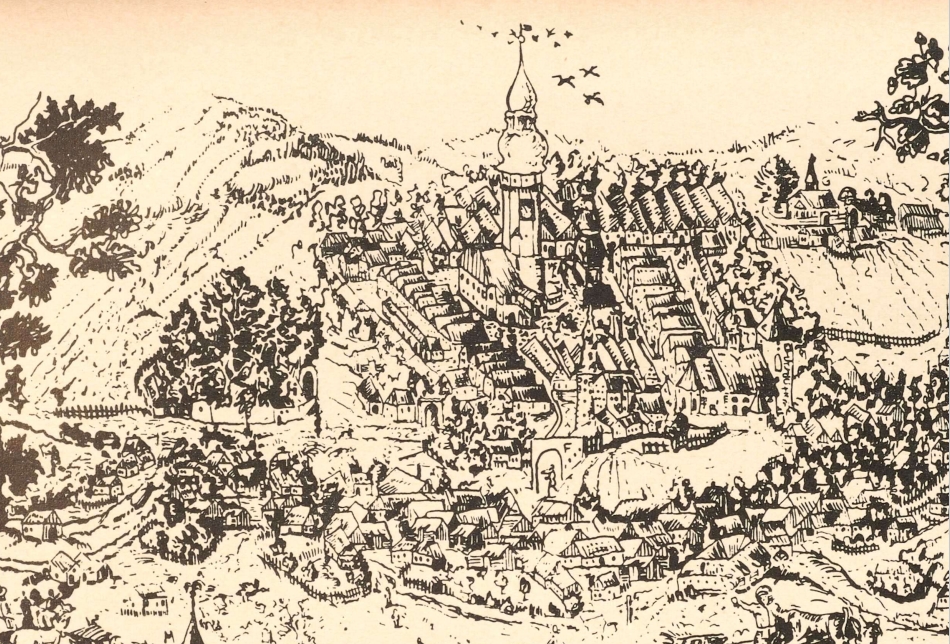
In 1834, the town had just under 3,000 German inhabitants (other ethnical groups were not mentioned in the statistics), at the turn of the century around 5,000, in the whole county around 25,000. The census 1921 shows more than 80 Brixels living in Römerstadt town and county. Today, the town Römerstadt (Rýmařov) is home to 8,000 residents, predominantly Czech.
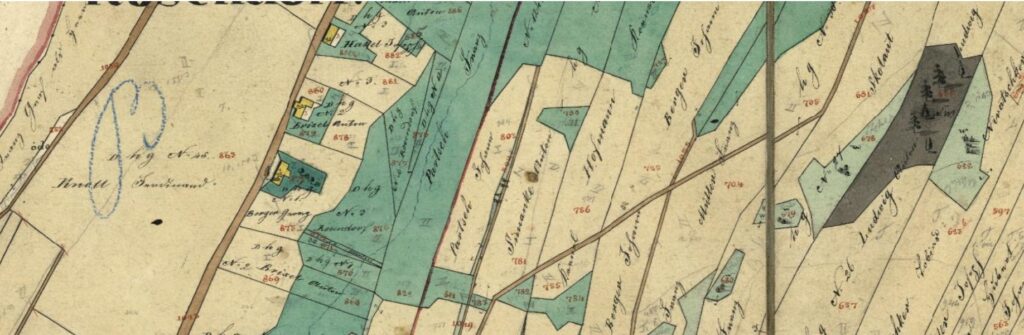
Land registry extract Rosendorf 1834 – to the left the middle house no.2, established by Anton Brixel (1724), now registered for his grandson Anton Brixel (1799)
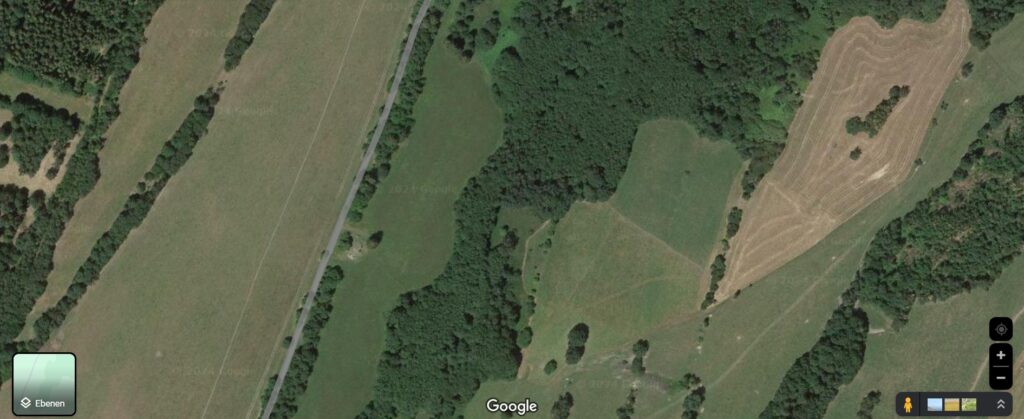
Satellite photo Růžová 2024 – to the left the single tree below the plot no.2